
Signs and labels
Describe the surface, color, and position of the text.
remove text from video
Remove visible text, captions, timestamps, labels, and burned-in overlays from MP4 or MOV video online while AI reconstructs the covered background.
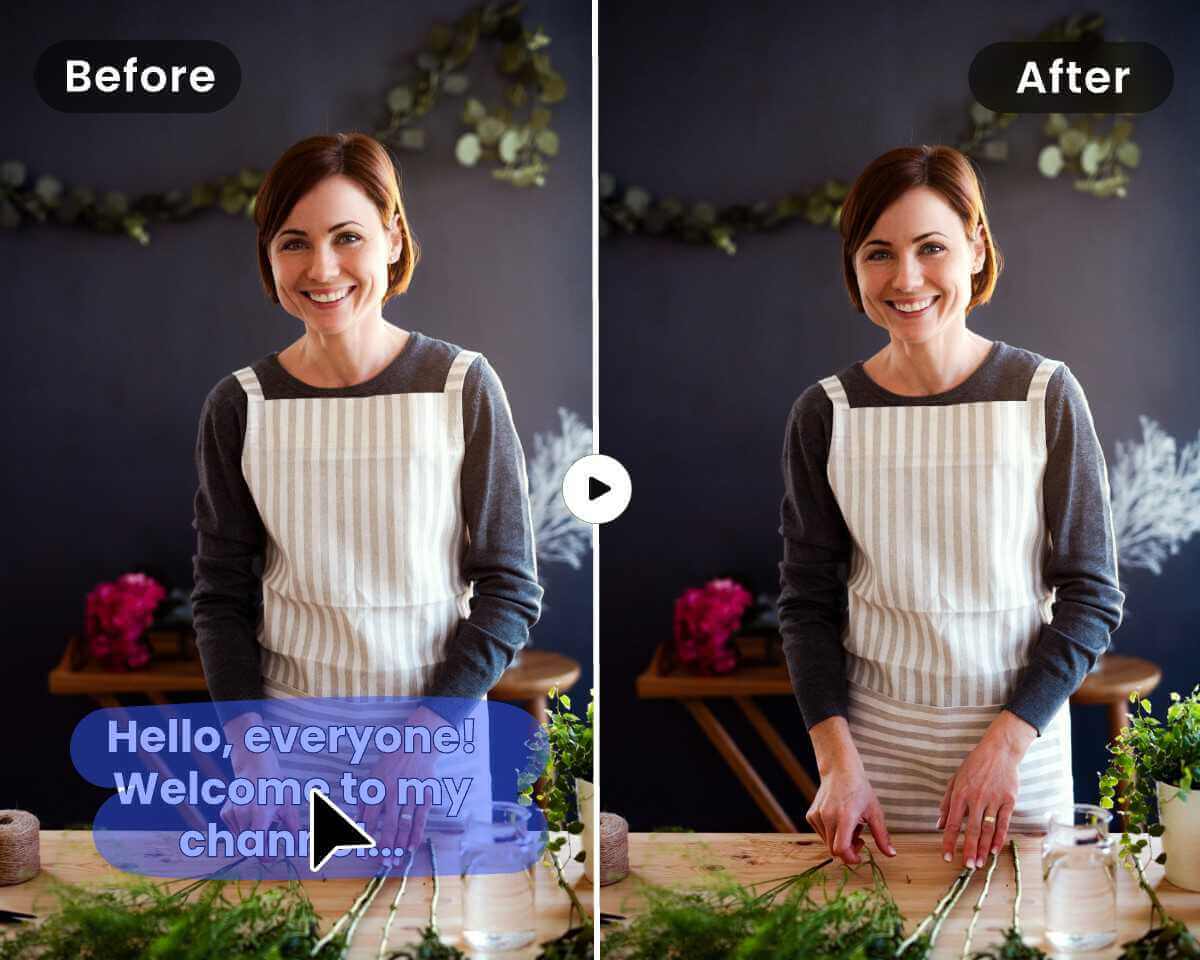
This page removes text visible in the frame. Selectable subtitle tracks should be removed in a player or editor.
This uses the live product workflow. Short, specific English prompts are usually steadier.
Short English prompts usually produce the most stable result. Your prompt is sent as written.
This owned demo shows the source clip and real processed result without presenting it as a page-specific result.
Fixed placement and clear boundaries make a target easier to identify in a prompt.
Describe the surface, color, and position of the text.
Works best when the overlay stays in one place over a stable area.
Targets visible text that has become part of the video pixels.
The tool uses your prompt to identify the target and rebuild the covered area from surrounding frames.
Make sure the text is clearly visible in the preview.
Write white date in the upper right instead of only remove text.
Review texture, subject overlap, and consistency during camera motion.
Describe both the text and where it appears in the frame.
remove the white text in the upper left cornerremove the date label at the bottom of the videoremove the black lettering on the wall signUse this page for general text. Use the dedicated pages for burned-in subtitles, authorized watermarks, or authorized logos.
Describe color, position, appearance, and motion instead of using a vague pronoun.
Short footage, stable backgrounds, and limited occlusion usually produce more consistent frames.
Check edges, texture, motion, and audio before using the processed video in a final edit.
You do not need AI for that. Selectable subtitles should normally be disabled or removed in the player, editor, or video container.
It can attempt moving text when the label remains identifiable. Fast motion, changing scale, perspective shifts, and overlap with a person make reconstruction harder.
Process one distinct overlay at a time when possible. Identify each item by color and frame position so similar text is not confused.
The system infers the covered area from nearby texture and surrounding frames. It cannot recover guaranteed original detail that is never visible anywhere in the clip.
Create and verify an account to test one clip up to 3 seconds and 50MB. If the encoded duration exceeds the limit by only one frame, the browser trims the clip and processes the first 3.0 seconds. The trial is not unlimited.
ObjectRemover accepts MP4 and MOV up to 1080p and 60fps. All plans support files up to 100MB.
Sources are deleted 24 hours after a job ends. Results stay for 7, 30, 60, or 90 days by plan.
You can choose whether to preserve source audio when submitting the job. Listen to the complete download afterward to confirm duration, sync, and content.
The result must be encoded as a new video. Upload the highest-quality source available and avoid repeated compression or low-quality social-media downloads before processing.
You can try, but describing one clear target per pass is usually steadier and makes it easier to identify which target or time range needs another attempt.
Trim to one continuous shot and add target color, position, appearance, and motion. If the target overlaps the subject for a long time, use a desktop editor with masks and tracking.
Upload a video and describe the text by color and position.